
This guide supports the development and review of Course Learning Outcomes (CLOs).
It provides a structured process for checking whether a CLO set represents the significant learning expected of graduates and meets regulatory, qualification, professional and discipline expectations. As you work through each step, record your evidence, thinking and decisions in the Designing Quality Course Learning Outcomes Template. Each section of the template matches a step in this guide.
If you are reviewing an existing CLO set, begin by locating the current approved CLOs in the Curriculum Design, Accreditation and Publication (CDAP) system. If you are writing CLOs for a new course, go to Step 2.
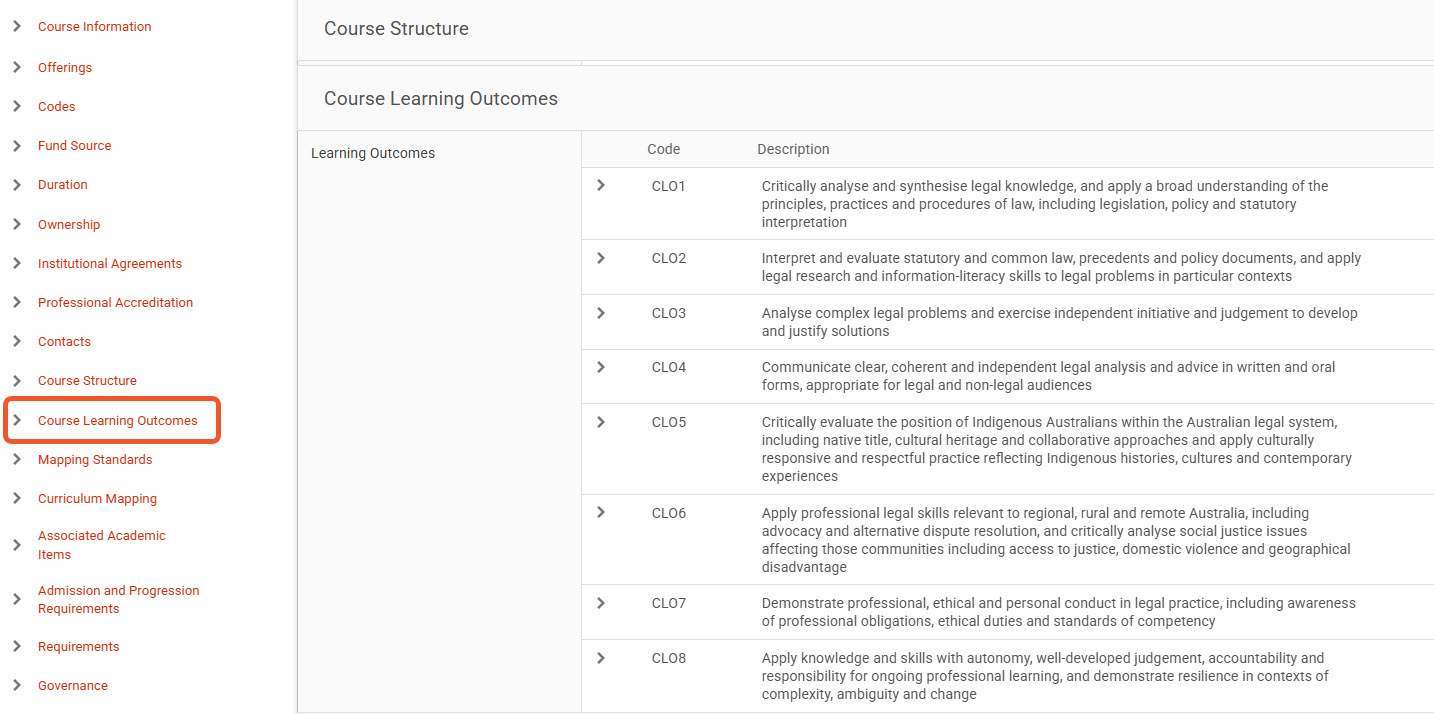
Before evaluating individual CLOs, establish what the course is designed to achieve. Review the course purpose, graduate profile and other relevant course documentation. Consider the broader disciplinary and professional context in which graduates will work or continue their study.
Do not rewrite the CLOs yet. Focus on the course as a whole. The aim is to establish an initial picture of the significant learning it is intended to develop.
The following prompts will help you to identify the learning that is most significant to the course:
If you are reviewing an existing CLO set, check your current CLOs once you have worked through the prompts. Add any significant capability they describe that you have not already identified.
Record each capability as its own row in the capability register in the template.
First Nations Cultural Safety
Charles Sturt’s Graduate Learning Outcomes (GLOs) now map to Subject Learning Outcomes (SLOs), where they are developed and assessed. The exception is the First Nations Cultural Safety GLO, which continues to map to CLOs. Your CLO set must include at least one CLO that develops and evidences it.
Students build this capability progressively, as described in the Indigenous Cultural Competency Pedagogical Framework (ICCPF). Early in the course, the focus is on generic understanding and critical reflexivity. By the end of the course, graduates apply cross-cultural and professionally specific skills in their discipline. Your CLO should describe the capability expected of graduates, in the terms of your profession or discipline. For example, a CLO about providing culturally safe care to First Nations patients is stronger than one about understanding Indigenous cultures.
Consider what culturally safe practice looks like for graduates of your discipline by the end of the course and record it in the first row of the capability register, which is reserved for it. If your course already has a First Nations CLO, you will review it against this capability alongside your other CLOs.
A strong First Nations Cultural Safety CLO:
If you’re not sure where to start, review the First Nations Cultural Safety GLO module in Brightspace. For advice specific to your course, contact Gulaay (GulaayDLT@csu.edu.au).
Next, identify whether your course is professionally accredited. Accredited courses usually have standards set by professional bodies, registration authorities or accreditation bodies.
Depending on the field, these may be called practice standards, professional accreditation guidelines or competency standards. Professional standards describe the knowledge, skills and capabilities graduates are expected to demonstrate and can help you identify the significant graduate capabilities that should be reflected in your CLOs.
Professional standards are generally available through the relevant accrediting body’s website. The Charles Sturt Professional Accreditation webpage can help you identify whether your course is professionally accredited, and which professional body is responsible.
Review the professional standards that apply to your course and the graduate capabilities they expect. If your course is not professionally accredited, check whether a discipline or industry body publishes standards or capability frameworks relevant to your graduates. If no standards apply, record this in the template and move to the next step.
Review the standards that apply to your course and the graduate capabilities they expect. Use the following prompts to guide your review:
Next, compare your course with others in the same field.
The Higher Education Standards Framework (1.4.1) requires that course learning outcomes are informed by national and international comparators. In practice, this means looking at how comparable courses describe what their graduates are expected to know and be able to do.
National comparators: Look at one or two comparable Australian courses of the same type and AQF level as your own. Most universities publish their CLOs on the course page of their online handbook.
Note the capabilities each expects of its graduates, then compare these with the capabilities in your capability register. Consider areas of commonality and difference, and whether there are significant capabilities reflected in comparable courses that warrant consideration in your own course.
International comparators: Look at a comparable international course, or a subject benchmark statement for your discipline. Benchmark statements can be more useful than an individual course, because they present a shared position across a disciplinary community rather than that of a single institution.
The UK Quality Assurance Agency publishes benchmark statements for around 70 disciplines, describing the nature of study and the academic standards expected of graduates.
Whichever approach you use, focus on the significant disciplinary capabilities rather than making direct comparisons of qualification level, as qualification frameworks differ between countries.
You now have an initial picture of the learning the course is intended to develop, informed by your course context, professional standards and comparator review.
You will now use the Australian Qualifications Framework (AQF) to test whether that learning is appropriate to the qualification being awarded.
The AQF sets expectations for the complexity, depth and breadth of learning, as well as the autonomy with which graduates apply their knowledge and skills.
Use the AQF levels and Charles Sturt course types table to find the AQF level of your qualification.
Next, review the descriptor for that level and consider what each of the AQF's three criteria means for graduates of your course:
Compare each capability in your capability register against these criteria record whether it sits below, at, or above the expected level. Revise the wording of any capability that sits above or below it.
You now have evidence of the course purpose, professional and discipline expectations, comparators, and the qualification level. Bring these findings together to determine which significant graduate capabilities belong in the CLO set, which are better represented at subject level, and which capabilities should be integrated into a single CLO.
Not every capability needs its own CLO. Some are better addressed through subject-level learning. Others are closely connected and belong together in a single integrated CLO.
Course level or subject level?
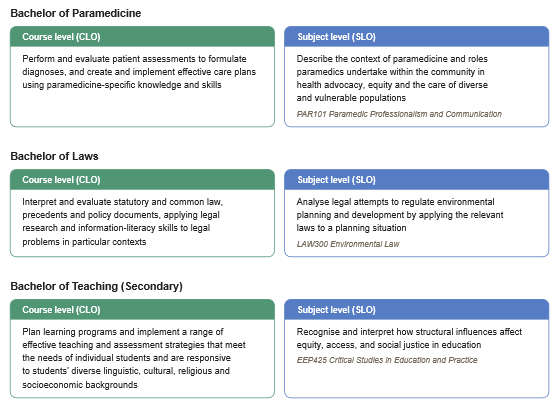
Distinguishing between course-level and subject-level learning is an important part of the CLO design process. CLOs should describe significant learning developed and evidenced progressively across the course, while SLOs describe learning that can be developed and evidenced within a single subject.
A useful test is to ask where the capability is developed and demonstrated. If it can be fully developed and evidenced within one subject, it likely belongs at subject level. If it is developed across several subjects, progressively becoming more complex and requiring more student autonomy, it likely belongs at course level.
An outcome is likely to sit at subject level if it:
The examples below contrast course-level and subject-level learning outcomes. As you review them, consider the scope of the learning each outcome describes and where that learning could reasonably be developed and demonstrated.
Separate or integrated: Many significant graduate capabilities are best represented as integrated capabilities. An integrated capability brings together the knowledge, skills and application a graduate needs to perform effectively in a particular context. The elements work together to enable the graduate to do something meaningful, often requiring judgement.
For example, a paramedic assessing a patient or a lawyer advising a client draws on multiple areas of learning at once. The knowledge and skills are not separate outcomes simply listed together; they work together as part of the capability.
When deciding whether capabilities should be integrated, ask:
Work down the capability register and decide, for each capability, if it sits at subject or course level and whether it stands alone or integrates with another. Where capabilities integrate, record the number of the capability each one joins.
If you are reviewing an existing CLO set, note which current CLO, if any, covers each capability. A capability with no matching CLO may need a new CLO, partial matches may need revising, and current CLOs that match no course-level capability may be removed.
You should now have a clear set of course-level graduate capabilities that the CLOs need to represent. Now, express each one as a clear, observable and assessable learning outcome.
A common structure for writing learning outcomes is:
Not every CLO will contain all three elements explicitly, but this structure provides a useful way to check that the intended learning is clear, meaningful and assessable.
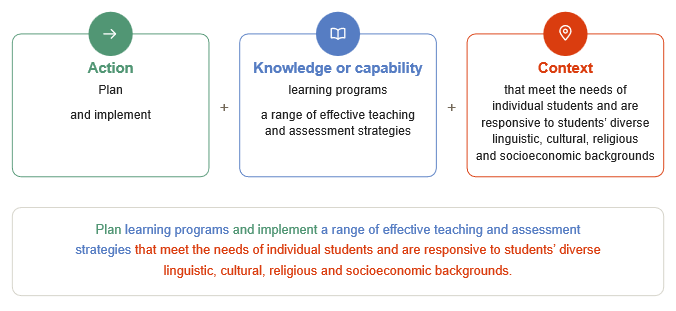
In the example below, the elements work together to describe one integrated capability. Planning and implementing are two actions that together describe a teaching capability. The knowledge or capability specifies what the graduate needs to plan and implement, and the context describes what the teaching needs to achieve.
Tips for writing CLOs:
Choose a verb that names observable performance: The verb should express how graduates evidence the integrated capability you have identified. Choosing a verb that names observable performance ensures a learning outcome is assessable. Avoid verbs such as understand, know or be familiar with, as they do not describe observable performance.
Use Bloom's Revised Taxonomy to find the right verb for your CLO: Bloom’s Revised Taxonomy describes learning in two dimensions (Krathwohl, 2002): a cognitive process (Remember, Understand, Apply, Analyse, Evaluate, and Create) and a knowledge dimension (Factual, Conceptual, Procedural, and Metacognitive). Considering both dimensions can help you check that the verb and cognitive demand are appropriate for the knowledge involved and the level of learning expected.
Iowa State University has published a helpful model that visualises the two dimensions as a grid. Each block shows an example outcome at the intersection of a type of knowledge and a cognitive process, with appropriate verbs for each process listed underneath.
Select a manageable, sustainable and appropriate number of CLOs: There is no set number of CLOs, that applies to every Charles Sturt course. However, a good guide is between three and eight CLOs, depending on the qualification type and AQF level.
Every CLO must be assessed, at more than one point across the course. Each CLO you add increases the assessment the course needs to provide, so a long list can quickly become unmanageable for staff and students.
The aim is a coherent set of distinct and significant graduate capabilities, without unnecessary overlap or outcomes that are so narrow they belong at subject level.
Once you have drafted your CLOs, review each one, then the set as a whole, using the review statements in the template. Where a CLO doesn’t meet a statement, return to the relevant step and revise it.
If you are reviewing an existing CLO set, finish by recording what happened to each current CLO, and why. Each one will have been retained, revised, integrated or removed.
Where to find additional support:
OurEducational Designers are experts in learning experience design. They promote evidence-based teaching practice and incorporate educational technologies to develop innovative curriculum.
Educational Designers can help you develop and evaluate your CLOs. Book an appointment via Charles Sturt Service Requests (Cherwell)
For support with First Nations Cultural Safety and Competency, contact Gulaay (GulaayDLT@csu.edu.au). Changes to how your course addresses Indigenous Australian content must be endorsed by the Indigenous Board of Studies, so engage with the Board early.
Writing CLOs is not primarily an exercise in finding the right verbs. It is about being clear about the significant learning expected of graduates and expressing that learning in a way that can guide curriculum design.
Once the CLOs are clear, the next step is to look across the curriculum and consider where and how each capability is progressively developed.
Australian Government. (2021). Higher Education Standards Framework (Threshold Standards) 2021. Federal Register of Legislation. https://www.legislation.gov.au/F2021L00488/latest/text
Australian Qualifications Framework Council. (2013). Australian Qualifications Framework (2nd ed.). https://www.aqf.edu.au/
Charles Sturt University. (n.d.). First Nations cultural safety graduate learning outcome. Division of Learning and Teaching. https://learn.csu.edu.au/d2l/home/11195
Charles Sturt University. (n.d.-b). Indigenous Cultural Competency Pedagogical Framework. https://policy.csu.edu.au/download.php?id=376&version=1&associated
Iowa State University Center for Excellence in Learning and Teaching. (2012). A model of learning objectives based on A taxonomy for learning, teaching, and assessing: A revision of Bloom's taxonomy of educational objectives. https://iastate.app.box.com/s/z0otio95lflaii1l2ro3h42kp8q6fdmm
Krathwohl, D. R. (2002). A revision of Bloom's taxonomy: An overview. Theory Into Practice, 41(4), 212–218. https://www.tandfonline.com/doi/abs/10.1207/s15430421tip4104_2
Quality Assurance Agency for Higher Education. (n.d.). Subject benchmark statements. https://www.qaa.ac.uk/the-quality-code/subject-benchmark-statements