People living with mental health conditions in Australia continue to experience poor physical health and reduced life expectancy, often due to preventable physical health issues that could be addressed with early interventions and screenings. These disparities are even more pronounced in rural and regional areas, where individuals with mental illness face nearly three times the risk of premature death compared to the general population (Roberts, Lockett et al. 2018).
The Mind and Body Care Navigators Project aims to develop a model of care for physical health care navigators to work within a multi-disciplinary community-based mental health team. The model supports individuals with mental health conditions to navigate and access care they choose for their physical health. This new model of care will integrate personal lived experience and lived experience of caring at its heart to improve physical health care outcomes for people with mental health issues.
We will be piloting this model in Dubbo and Bathurst in New South Wales and in Bundaberg in Queensland. By working collaboratively with our partners and physical health care navigators, participants will identify key areas of their physical health they would like to improve.
Through this process, we will evaluate the feasibility and acceptability of three types of Physical Health Care Navigators (PHCNs): those with personal lived experience (peer PHCNs), carers trained as PHCNs, and mental health professionals acting as PHCNs. The trial builds on the National Lived Experience (Peer) Workforce Guidelines (National Mental Health Commission 2021) and addresses structural discrimination in the health sector, as outlined in the National Stigma and Discrimination Reduction Strategy (National Mental Health Commission 2022).
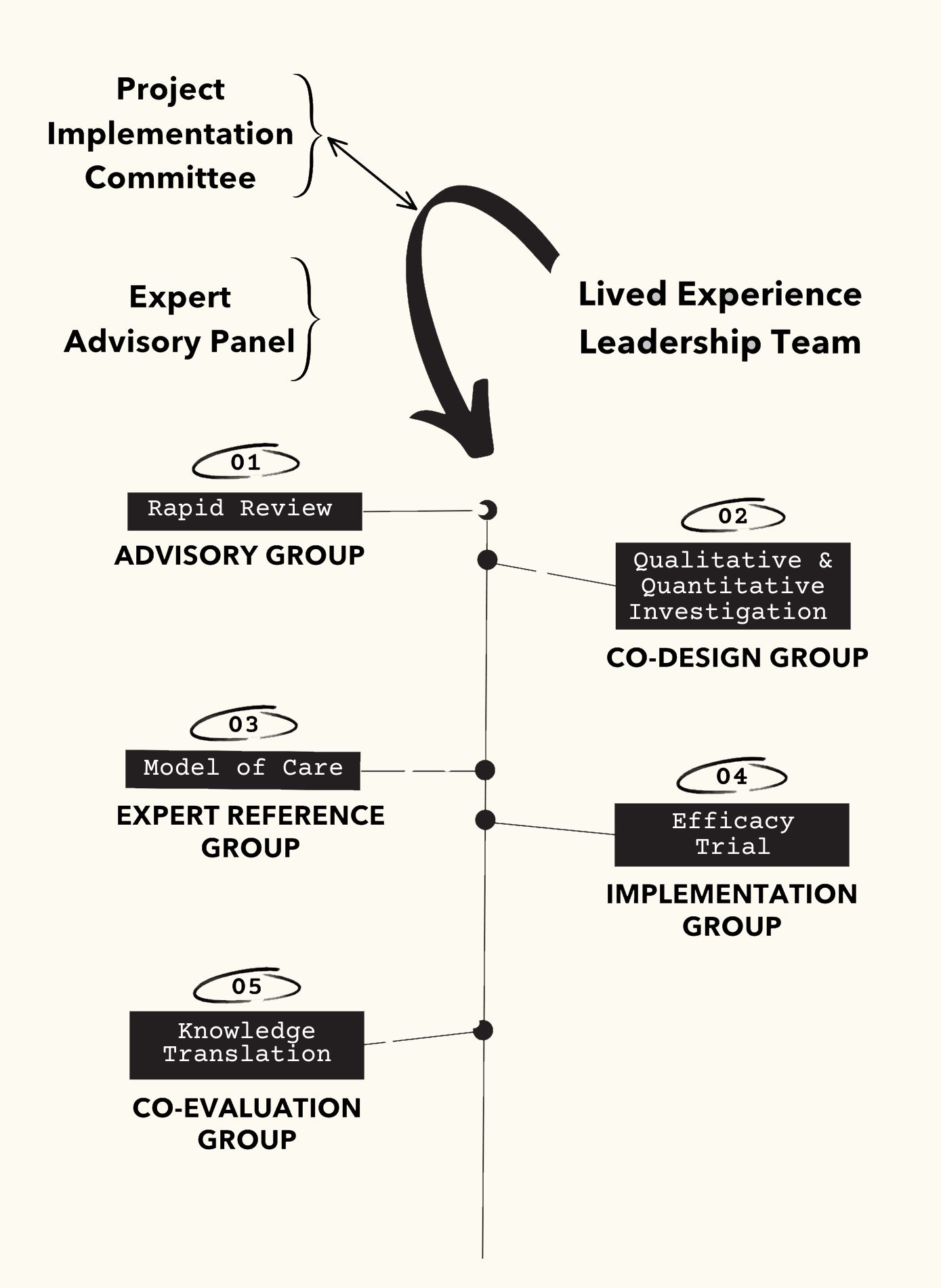
We’re delivering this project in four major stages:
This process is illustrated in the flow chart developed by Alex Li who is a member of our Lived Experience Leadership team.
Our Project Implementation Committee will work with our Live Experience Leadership team to deliver this project in five stages.
Review literature on how care navigators improve physical health in people with a lived experience of mental ill-health.
November 2023 – March 2024
Find out how consumers and carers seek and find physical health care.
Find out what rural mental health workers need to provide good physical health care.
March 2024 – February 2025
Co-design a Physical Health Care Navigator (PHCN) model of care including a Peer Worker Navigator, a Carer Navigator, and a Clinician Navigator.
February 2025 – September 2025
Test the acceptability and feasibility of this model in a trial across 4 partner sites in regional NSW and QLD.
September 2025 – July 2026
Share what we learn to improve services.
July 2026 – December 2026