
Sustainability
- Home
- Locations
- What you can do
- LiFE Framework
- Sustainable Development Goals
- About us
- Grants
- Events
- Contact us
Now searching for:
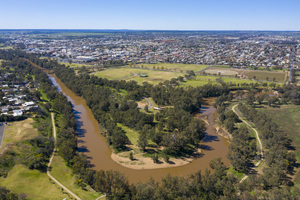
Charles Sturt leads the Commonwealth Environmental Holder Science Program: Flow Monitoring Evaluation Research (Flow-MER) in the Murrumbidgee region. Flow-MER is the Commonwealth Environmental Water Holder’s science program, working in partnership with scientists, water managers and communities across the Murray–Darling Basin. The program’s aim is to understand how rivers, wetlands, floodplains, and the plants and animals depending on them, are responding to Commonwealth environmental water.
Knowledge sharing and community involvement are key components of the program, ensuring active promotion of water monitoring and management in the wider community. In the Murrumbidgee catchment, researchers have joined with the Mutthi Mutthi, Nari Nari, Wiradjuri and Wemba Wemba people at sites across their traditional lands, through knowledge sharing meetings, Community Yarn-ups and Wetland Wanders. These activities are designed to build two-way relationships with First Nations stakeholders, enable their participation in the program and continued connection to wetlands. This ensures Indigenous knowledge, cultural values and priorities meaningfully inform environmental research and commonwealth water management.
The program also provides educational opportunities for the local community including field days, webinars, school based programs and citizen science activities to grow local knowledge of water management and the ecosystems it supports. Researchers also engage with Indigenous Rangers, offering opportunities to connect and work on Country and learn new skills.
The Farm Water Management Planning project engaged hundreds of farmers, landholders and technical experts in the Riverina, Murray and Southeast NSW to take practical steps to assess and evaluate their water needs, storage and delivery. The program was delivered by the Southern NSW Drought hub, which is hosted by Charles Sturt, and Murray Local Land Services.
Through the program, farmers developed Farm Water Management plans enabling them to implement conscious water usage on farms. The program offers a variety of templates available to the public including water management plans, calculators and guides, ensuring farmers are prepared for drought.
Professor Andrew Hall's Smarter Water Delivery to Enhance Wetland Ecology Across the Murray-Darling Basin and Beyond project is improving environmental water management through cooperation on water security with the NSW Department of Climate Change, Energy, the Environment and Water and the Commonwealth Environmental Water Office. Using LiDAR, hydrological modelling and satellite data, the project helps environmental water managers better understand how water moves through wetlands, supporting more effective and evidence-based water delivery across the Murray-Darling Basin.
The project contributes to regional and national water security by translating research into practical tools for sustainable water management. By improving the effectiveness of environmental watering programs, Professor Hall's research helps protect wetland ecosystems, enhance biodiversity and build the capacity of government agencies and water managers responsible for managing Australia's freshwater resources.
Locally and globally, Charles Sturt researchers are working in cooperation with community and government agencies on water security, quality and ecology.
Through our Gulbali Institute and School of Engineering Charles Sturt has worked in collaboration with WaterNSW to understand the impact of thermal stratification on water quality in water reservoirs , such as Oberon Dam. Khin July Win Thant’s PhD research focused on declining water quality, due to low oxygen levels in Oberon Reservoir in New South Wales, comparing conventional aeration methods with an innovative solar-powered solution. The research fills an important engineering knowledge gap and provides practical knowledge to support sustainable water quality management.
In partnership with the Oppenhemier Generations Research and Conservation (OGRC), Charles Sturt leads the Southern African Rivers Initiative. The applied research initiative is focused on water resource protection, biodiversity and conservation, fisheries research and capacity building and training in one of the most biologically diverse and vulnerable ecosystems in the world.
The project works collaboratively with government and non-government stakeholders, providing ecological risk assessments, environmental flow and sustainable water resource management strategies and conservation services. The team are also actively involved in community outreach programs, from local school events, presentations and public talks to global fish migration forums and conservation activities in the region.
Find out more about
Charles Sturt researchers working towards the Goals