27 March 2026
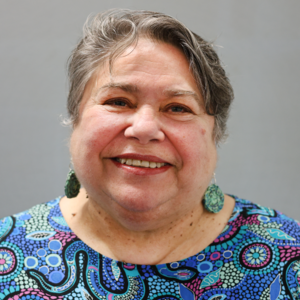
Over the next few months in SPOKE, we’ll be introducing you to the members of the Hub’s First Nations Engagement Group. First up is Sue-anne Cutmore, a long-time community advocate on the NSW South Coast whose career has been dedicated to supporting families and strengthening communities.
Tell us a little about yourself and your background.
I was born in Moree in north-west NSW, but my parents moved our family to Sydney when I was young, for work and education. I grew up in Balmain then as a moved around a lot - Darwin, Cairns, Sydney, Nowra - before eventually settling on the South Coast, where I’ve lived ever since.
I’ve raised five children altogether and now have a very big family - I think we’re up to 17 grandchildren, including greats.
Workwise, most of my career has been in community services. I’ve worked in legal firms, at the Community Justice Centre as a mediator, in disability services, and as an Aboriginal liaison officer at the local hospital and many part time roles in community afterwards. My most recent has been in a Family Relationship Centre as an Indigenous Service Advisor/Family Dispute Resolution Practitioner.
So really, my whole working life has been about serving people and serving my community.
What are you most passionate about in your community work?
I want to level the playing field. That’s really what I’d like to see - communities having equal access to resources and opportunities.
Education is a big part of that for me. The system is still very rigid, and it doesn’t work for everyone. It doesn’t recognise that people have different learning styles and different ways of understanding the world.
For Aboriginal kids especially, the system can still be very discriminatory. It’s not always intentional, but the way things are structured means some students are set up to struggle. I think we need to think much more broadly about how education works and who it works for.
You experienced the 2020 bushfires on the South Coast. What did that period teach you?
Bushfires have been part of life on the property where I lived for decades.
After one major fire in the late 1990’s - early 2000s, when we returne home from WA, the bush was completely devastated. The wildlife that used to live on our property - wombats, wallabies, kangaroos - had disappeared, and the bush that grew back wasn’t always healthy. A lot of black wattle took over, which blocks light and makes it harder for grasses and other plants to regenerate.
The more recent fires during the Black Summer of 2019-20 were incredibly traumatic for the community and once again we were faced with the devastation of the surrounding areas.
After those fires, I became involved in a research project looking at recovery and resilience on the South Coast. Part of that work involved talking with people about their experiences of the bushfires, and what really stood out to me was how many people hadn’t had the chance to properly talk about what they’d been through. A lot of people were still carrying that trauma.
For some families, the challenges didn’t end when the fires were out. People were trying to access support such as financial assistance, food, and accommodation, and some felt they weren’t being heard. For Aboriginal families especially, there were experiences of discrimination that added another layer of hurt at an already devastating time.
Even now, years later, it still feels very close.
It shows how important it is that people are listened to, and that communities have space to tell their stories and be part of the recovery process.
What role do you think First Nations knowledge plays in land and fire management?
One of the things that stood out during the fires was how important local knowledge is.
There were moments when people from the community could see exactly how the fire was moving across the landscape. In one case, local Aboriginal men advised that the fire had shifted direction. Acting on that knowledge, a back burn was carried out that helped save homes.
That kind of knowledge - knowing the land, understanding how country behaves - is incredibly valuable.
More people are starting to listen to that now.
What does “caring for Country” mean to you?
For me, caring for Country sits at the centre of everything. If you care for Country, Country cares for you. It’s reciprocal.
We’re starting to see communities come together around that idea; Aboriginal and non-Aboriginal people working together to restore landscapes, replant bushland and look after the environment.
It’s everyone’s responsibility.
What motivates you personally to keep doing this work?
Family and community.
I really believe we are shaped by the people around us when we’re growing up. My mum was a nurse and my dad worked as a drug and alcohol counsellor. Now I’m a social worker, my sister is a nurse, and my brother works in alcohol and drug counselling.
So, caring for people has always been part of our family.
What are you looking forward to about being part of the Hub’s First Nations Engagement Group?
A lot of the issues we’re talking about - climate, land management, community wellbeing - they’re all connected and overlap in circles. Nothing sits in isolation.
If we can bring different perspectives together and keep Country at the centre of the conversation, I think that’s a really positive step.