
Conflicts of interest explained
A conflict of interest (COI) is when your personal interests and professional duties conflict.
Glossary
-
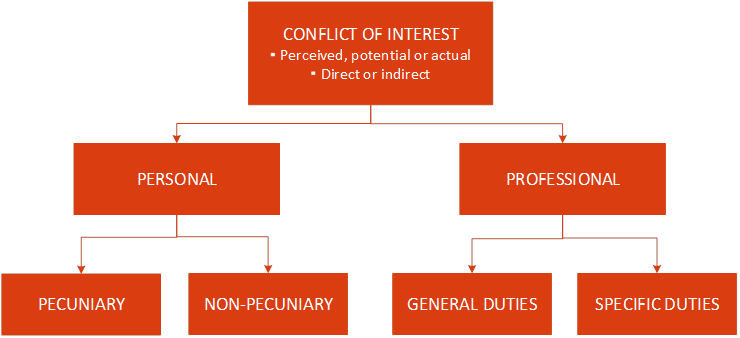
Perceived, potential or actual conflicts of interest chevron_right
Conflicts of interest can be actual, potential or perceived.
Actual
These conflicts currently exist between your personal and professional interests. An example is being on an interview and selection panel where you have a personal relationship with one of the candidates.
Potential
This type of conflict does not currently exist but there are factors that have the capacity to develop a conflict. For example, your committee makes funding decisions that may impact the course your child is enrolled in.
Perceived
Those where it might appear to others that your behaviour has been or could be influenced by your personal interests. An example is if a student is a family friend, others may think this could influence the way you will teach, assess or support them.
-
Direct or indirect conflict of interest chevron_right
All conflicts of interest are either direct or indirect.
A direct conflict of interest is when you are likely to be personally affected if a matter is decided or actioned in a particular way.
An indirect conflict of interest is when a relative or close associate has an interest in something that you can influence, action or decide on.
-
Personal interests chevron_right
Personal interests are generally divided into two types:
Pecuniary interests
Pecuniary interests involve potential financial gain or loss. Money does not have to exchange hands to be a pecuniary conflict of interest. You may have a pecuniary interest if you:
- own property
- have investments in an organisation
- receive benefits of some kind which may influence your decisions at work.
For example, the desire for promotion.
Pecuniary interests are also referred to as 'monetary interests' or 'material personal interests'.
Non-pecuniary interests
Non-pecuniary interests are personal interests that do not involve a financial component. They are personal relationships with:
- family
- friends and associates from clubs
- sports teams
- cultural activities.
Non-pecuniary conflicts of interest can be prejudice due to a personal relationship (e.g. friendship or animosity) which leads to a bias in judgement or decision, even though there is no financial benefit.
-
Professional interests chevron_right
Professional interests include the general duties of all Charles Sturt staff, as well as duties specific to the role, or roles, you hold within the University.
General duties involve maintaining standards of professional conduct in accordance with the Code of Conduct including but not limited to behaving ethically and ensuring confidentiality of information.
Examples of specific duties include the work required of you as part of day-to-day operations, the procurement of goods and services, or participating in a committee, working group or panel including recruitment and selection of new staff.
Contexts in which a COI may arise
-
Day-to-day operations chevron_right
There are many different contexts in which a COI may arise while carrying out your general and specific duties within the University. These include:
Direct interests
You are personally affected if a matter is decided or actioned in a particular way, such as:
- Improving your own financial or social status by being involved or receiving a gift, benefit or award.
- Awarding a contract to a business you have financial stake in.
- Sharing confidential information to advantage yourself.
Indirect interests
Potential conflicts of interest arise if your relative or close associate has an interest in something that you can influence, action or decide on. For example:
- Administrating student records or participating in decisions relating to the assessment or grade determination for a relative.
- Influencing or affecting a close friend’s admission or opportunities at the University as a student.
- Engaging a relative in casual work and/or providing supervision including timesheet approvals.
- Influencing or affecting a former colleague’s recruitment or promotion due to personal animosity.
- Awarding a contract to a business owned or managed by your spouse/de facto/partner.
- Affecting a business associate’s financial or professional status by promising a promotion or conference attendance.
- Sharing confidential information to advantage a business associate, e.g. about research conduct or grants, legal proceedings or confidential committee deliberations.
All conflicts of interest relating to ongoing or temporary duties—including financial interests, affiliations and personal relationships with another employee or student—must be declared. The Conflict of Interest Declaration form must be completed in consultation with your direct supervisor, approved by your Band 7 or above leader and submitted to DPC.
Where a previously declared COI has changed or brought about a COI requiring separate management, a new declaration may be required. This includes contexts brought about by previously approved additional employment. To determine whether a new COI declaration is required—or if existing mitigations need to be updated—review guidance on monitoring and formal review, then discuss the matter with your supervisor or other senior leader.
-
Committees and recruitment panels chevron_right
If a conflict of interest arises through participation in a committee or recruitment panel, the conflict must be declared on each occasion and managed through the appropriate process. This includes making a disclosure at every committee meeting where business under consideration relates to the conflict.
You may use DPC’s declaration form to submit your COI directly to the Chair or Talent Acquisition.
If the context also affects your day-to-day activities, you must make disclosures to both the Chair/Talent Acquisition and to DPC.
-
Additional / secondary employment chevron_right
Additional (also known as secondary) employment and University consultancies can bring about situations which may:
- Conflict with an employee’s University duties
- Compete with or affect the University’s interests
When multiple jobs are held, it can become difficult to keep duties separate. This is known as a conflict of duty. Conflicts of duty is more likely when:
- An employee’s total weekly hours exceed a full-time load
- Adequate rest periods cannot be maintained
- Roles have a competitive relationship
- One role has a regulatory or managerial role over the other.
Conflicts of duty are serious because they can lead to poor performance, an unsafe workplace and/or unlawful or improper decision-making.
To guard against conflicts of interest, Charles Sturt continuing and fixed term employment contracts prohibit staff from engaging in any trade, business or occupation without written approval.
The Employment Conditions Procedure - Additional Employment and University Consultancies outlines the approval process if you are considering any employment or activity outside of your current University role. You can also refer to information on declaring a conflict of interest.
Examples of additional employment include:
- A second job outside the University (casual, fixed term or continuing)
- Any trade, business or occupation outside the University, including self-employment
- One-off or ongoing activities required for professional registration
- Multiple roles within the University, such as staff who both teach and provide student support then encounter the same student in both capacities
Complete a Request for Approval for Secondary Employment form
-
Receipt of gifts or benefits chevron_right
Staff have responsibilities relating to receiving gifts from other Charles Sturt employees or any party external to the University.
You must refuse gifts of cash (or any gift or benefit that can be readily converted into cash) as well as when it could be perceived that it was provided to influence your decision-making. If you are not in a position to refuse a gift or benefit, you must immediately pass it on to your supervisor.
Otherwise, depending on the nature and value of the gift or benefit, it may still be appropriate to refuse the gift or declare receipt of it to your supervisor and DPC.
All gifts with a value in excess of $100 must be declared no later than 30 days after the receipt of the gift (or no later than 30 days of returning to Australia for gifts received overseas). In accordance with the COI Procedure, your declaration of the receipt of a gift and any surrendered gift will be provided to the University Secretary.
Examples of gifts and benefits include:
- gifts of alcohol, clothes, products, restaurant meals and beverages
- preferential treatment such as queue jumping, discounted travel or free use of facilities such as gyms and holiday homes
- hospitality such as corporate offers of transportation, accommodation, tickets, meals and functions as part of a major event
- sports team sponsorship.
Consequences of non-compliance
Any conflict of interest can have real and lasting effects on the University, such as:
- distress impacting staff wellbeing and morale.
- damage to personal and organisational reputation.
- resource waste and loss of revenue.
- distorted competition for resources.
- inequity.
All COI types must be declared so that they can be managed appropriately.
Breaches of policies and procedures relating to conflicts of interest may be detected through the University's own internal mechanisms or through external oversight (e.g. independent auditors).
Consequences for non-compliance with policies and procedures relating to a conflict of interest are proportional to the seriousness of the offence. Examples of consequences include the individual being:
- counselled regarding their behaviour.
- given a written warning.
- dismissed, with or without a period of notice.
- reported to a regulatory body if the behaviour amounts to a criminal offence.
Further questions
For help identifying or managing a conflict of interest, please first contact your supervisor.
You can also contact another senior officer within your work area. If you are still unsure, it is safest to complete a declaration.
Should you require help, you or your supervisor can email dpc@csu.edu.au