Download the case study
Background
Through ongoing conversations with Local Land Services' Drought Adoption Officer Martin Preuss, Jono was able to move from considering a stock confinement feeding area to designing and building one.
The result is infrastructure that is already changing how feed, water and livestock are managed while helping protect valuable groundcover during dry periods.
Jono's story highlights how trusted local expertise can help producers make confident decisions that strengthen drought resilience and prepare for increasingly variable seasons.
Turning information into action
Jono Schulz is a fourth-generation farmer at Huonlea and the Chair of West Hume Landcare. His family has a long history of investing in natural resource management, including fencing waterways and protecting remnant vegetation, while operating a sheep, cattle and cropping enterprise.
Jono first met Drought Adoption Officer Martin Preuss at the Henty Field Days, before reconnecting at a Murray region workshop that was part of the Hub’s Farm Water Management Planning project. Conversations about livestock nutrition, water supply and confinement feeding continued over several events, helping Jono explore how a confinement feeding area could work on his property.
Good advice supports confident decisions
After attending another event focused on managing sheep in variable seasons using confinement feeding areas, Jono invited Martin to visit Huonlea and help assess potential locations.
"I'd been thinking about it for years and wasn't sure exactly where to put it," Jono said. "I got Martin to come out and do an inspection of the potential sites we'd been considering."
Drawing on his experience, Martin assessed options and developed a design that considered access, existing infrastructure, water availability and proximity to roads.
"He said this one is probably the best site because it's next to the wool shed, far enough off the road, but with some infrastructure already there."
Martin's initial design included 12 pens, but Jono adapted the layout to better suit his operation, ultimately creating 20 smaller pens for managing stud sheep and smaller mobs.
The process gave Jono confidence he was making a sound long-term investment while tailoring the design to suit his business.
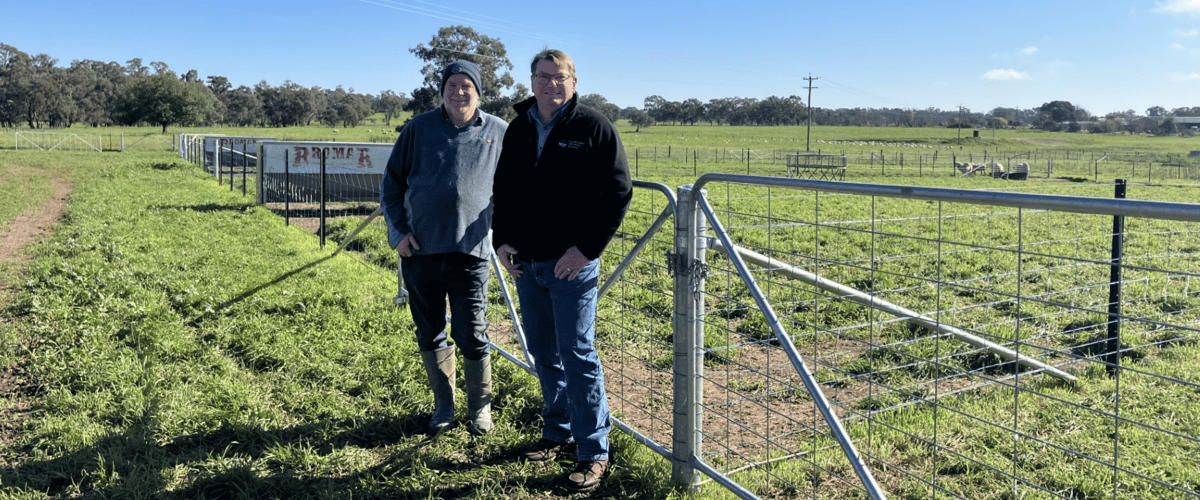
Jono Schulz and Drought Adoption Officer Martin Preuss at the Huonlea stock confinement area
Ensuring access to quality water for livestock
Construction began during the drier months of 2025 and, although the facility is still being refined, Jono was using the confinement feeding area by February 2026.
For Jono, the trigger for putting sheep into confinement this year was a need for more paddocks for stud ewe joining. By February, the ongoing dry conditions meant that around 20 of the dams on Huonlea were dry or not safe for stock to drink from. The dams they did have left were all being used by different stock classes.
Therefore, the new confinement feeding area ensured access to quality water for the ewes, as well as making it easier to feed them and manage joining.
The benefits became apparent almost immediately
"It worked pretty well having them [the stud ewes] in the pen for joining," he said. "You can feed them every day, and you notice what's going on."
During joining, one of the rams died unexpectedly. Because the sheep were being monitored closely in the confinement area, the issue was identified quickly and the affected ewes were promptly allocated to another ram.
"If they'd been out in the paddock it might have taken a lot longer to realise."
The confinement feeding area has also changed the way feed is managed across the property.
"Before [in dry times] we'd be feeding sheep by trailing grain out in the sacrifice paddocks, which meant driving out all over the farm and that takes a lot of time, and wages that need to be paid.”
Building flexibility for future dry seasons
Perhaps most importantly, the stock confinement feeding area infrastructure provides greater flexibility for the farm when seasonal conditions deteriorate. With livestock able to be moved off pastures earlier, Jono can better protect groundcover and pasture while reducing pressure on paddocks.
"The confinement feeding investment we’ve made is an evolution for us from small sacrifice paddocks into fully set up drought lots," he said.
Investing in resilience
For Jono, the confinement feeding area represents much more than a new piece of infrastructure. It is a long-term investment in the farm's resilience.
"I'm quite proud of having made the investment and gotten the stock confinement feeding area up and running," he said. "It's building some resilience for the farm."
Even in a season like 2026 where it has not yet been heavily relied upon, there is comfort in knowing the system is ready when needed.
"Even though I didn't really need it much this year, it's nice knowing it's ready for summer and that we can turn it on and off as we need."
Through the Future Drought Fund’s investment in the Drought Adoption Officer program (via the Southern NSW Innovation Hub), producers like Jono gain access to trusted advice, practical decision support and proven drought-management strategies. In this case, that support transformed an idea years in the making into an on-farm asset that will benefit the business for decades.
The next step is sharing those lessons with others. In September 2026, Huonlea will host other local producers for a field day to see the stock confinement feeding area in action, helping build knowledge, confidence and drought preparedness across the wider region.