Background
Jean Bentley is the Landcare Coordinator for the Far South Coast Landcare Association, a volunteer organisation that supports groups and individuals working to improve land and water resource management in the region. Through the CEO of the Bega Regional Circularity Cooperative, who sits on the Far South Coast Landcare board, Jean was introduced to Southern NSW Innovation Hub Knowledge Broker Chloe Wilson while Chloe was working within the Cooperative.
Supporting local farmers
For around 17 years, one of Far South Coast Landcare’s core activities has been a Farmers’ Network for local beef and sheep producers, but for the past five or six years they haven’t had the resources for a paid coordinator to manage the group – and that’s where the Bega Knowledge Broker was able to provide support.
Jean said, “We had run one or two events a year [for the Farmers’ Network], and I circulated newsletters, but we haven’t been as active as we used to be in connecting those farmers, hosting events and surveying them about their needs – that was something Chloe was able to help us with.”
Reinvigorating an existing network
Jean described how Chloe helped reinvigorate Far South Coast Landcare’s Farmers’ Network through events including soil health workshops, an Ocean to Earth composting workshop, and silage wrap recycling initiatives.
For many South Coast producers, silage is an important tool for managing drought. Ensuring silage can be produced sustainably, including through the recycling of silage wrap, helps support its long-term use as a drought resilience strategy.
Chloe also played an important role in bringing groups with aligned interests together. As Knowledge Broker, Chloe facilitated networking and conversations by attending evening meetings with Bega Beef and coordinating displays at the saleyards with Local Land Services, the Department of Primary Industries and Regional Development, Landcare and Bega Beef.
Jean said, “For groups like Bega Beef that didn’t have a paid coordinator, [having Chloe engaged] felt like there was somebody there who cared and was able to take their concerns and pursue solutions.”
Understanding and acting on local needs
When starting out in the role in Bega, Chloe conducted a survey of key stakeholders from across the region, including Far South Coast Landcare, so she could better understand their resilience needs and identify easy opportunities to make a difference.
Jean said, “Everyone just appreciated there was someone on the ground pulling that together and having tangible results fairly quickly.”
Growing soil health knowledge
The survey identified that members of the Farmers’ Network were particularly interested in learning more about their farm’s soil health and getting some training on how to interpret test results.
“Chloe used the same model that we'd run with the Farmers’ Network by offering subsidised soil testing and a follow-up training event to look at those results.”
With joint funding from Far South Coast Landcare and Bega Regional Circularity Cooperative, Chloe was able to facilitate multiple on-farm soil health workshop days for local producers.
Jean said, “It was a lot of collaboration where you need someone [Chloe] to really keep all the balls in the air. The soil workshops simply didn’t exist without Chloe.”
These events were well attended, with some of the highest participation rates Jean had seen in many years.
“It certainly created a buzz that got conversations happening,” said Jean.
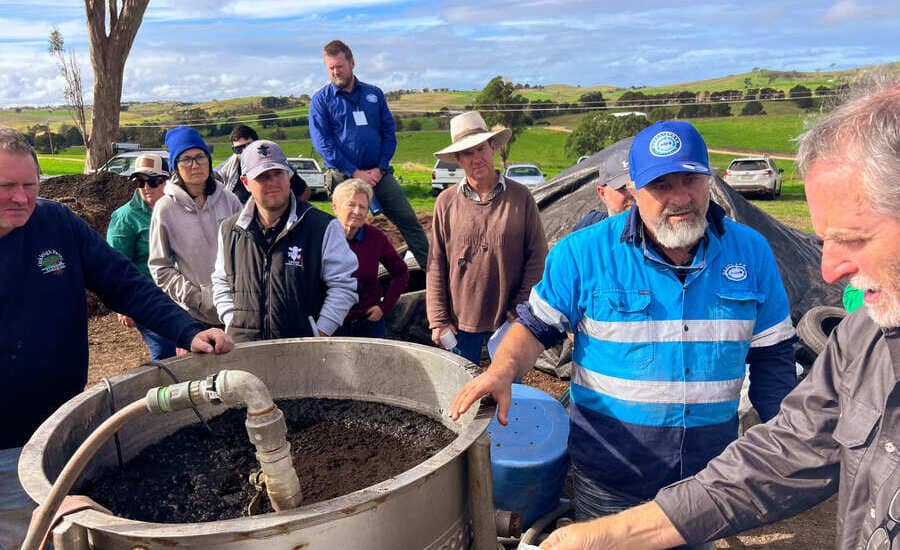
Farmers learning about soil and fertiliser at a workshop on the South Coast of NSW in May 2025
Building connections among landholders
Jean observed that the workshops were about much more than information sharing and learning.
“Equally important were the connections that landholders were having with other landholders and organisations. I was often attending those events and then following up with landholders on other things that we [Far South Coast Landcare] were doing with them, which led to more support for other projects that weren't drought related,” said Jean. “Those conversations and where they lead often aren't captured in feedback forms, but there are ripple effects.”
For example, at one of the events, Jean ran into a farmer she hadn't seen in a while. That conversation helped revive a stalled rock-works project to protect a high-value hanging swamp wetland that had been sitting idle for years.
Increasing drought resilience
Chloe’s role as a Hub Knowledge Broker based in Bega provided drought resilience benefits for the Farmers’ Network by increasing knowledge of soil health, moisture retention and carbon management. When it comes to practice change, Jean noted that it can take time.
“Often the actions don't happen immediately. Practices change gradually and need follow-up support.”
Lessons and looking forward
Jean explained that the network coordinator role is a valuable one, for a range of reasons, and it would be good if funding for the position could be less ad hoc.
She said, “Funding for coordinator roles always fluctuates… It was clear in my committee's mind that we needed a coordinator if the Farmers’ Network was going to make changes on the ground and enable farmers to adopt the knowledge out there.”
Coordinators can also help bring people together and take their ideas to the next level, particularly in agriculture where farmers are already stretched and isolated. “It's so important for mental health and keeping farmers feeling connected during droughts,” said Jean.
Jean said, “With Chloe on the ground as Knowledge Broker, she was able to fill some of this void, and that’s been a good morale boost for both the local farmers and Bega Beef.”
“You would hope the lesson learned is that farmers need somebody to connect them, a good communicator who has the time to sit down with them and join all the dots, which Chloe did so well.”